Sunday, November 4, 2012

Radio and the Ethics of the FCC

The radio was probably one of the most revolutionary inventions of it's time. Radio stations had and still have a large power to influence their listeners in some of their most personal parts of their daily lives.

The United States' Federal Communications Committee (FCC) is the governmental body that oversees all radio and TV stations to make sure that the stuff that is getting aired is "proper" for people to hear. 

"Created by Congress in 1934, the FCC has myriad responsibilities. On broadcast television, the FCC enforces the federal laws that effectively preclude explicit content from appearing on over-the-air programming: no obscenity whatsoever, while indecency and certain profanity are only permitted between 10 p.m. and 6 a.m," said  Jamshid Ghazi Aska.

The FCC standards of rules and regulations of what goes on over air are particularly vague, misleading and outdated for where we are in 2012. For a quick example, you can say "Penis. Vagina." or "poop" on air, however "Penis and Vagina." and "I'm pooping" are HUGE radio no-nos that can cost thousands of dollars to the station and it's licence holder. 

Is this ethical? Can a governmental entity act as a smut police safeguarding our children from dirty things like sex and poop? 

These rules were put in place during a time where "family-oriented programming" were forefronts in american values -- I'm not sure if, as a country, America has become less family-oriented or more realistic. In a communitarian sense, these regulations are pretty unethical -- they essentially safeguard against free-speech programming and make Disc Jockeys weary of everything they say that can incense the FCC. 


Speaking of incensing the FCC, the minimum dollar amount they can fine a station when they make ANY infraction, let it be a quick "I'm pooping" on-air or forgetting some sort of unimportant paper in their public file to forgetting to give a Station ID at the top of the hour is a cool $10,000. 

When a station, especially a non-commercial, student-run station can be charged over half of their YEAR'S operation budget, a small infraction can easily put a station off-air permanently. 

The FCC knows this, and readily enforces their sanctions like no other. Is this ethical? 

DOUBTFUL. In the 21st century, it's hard to maintain relevancy when you are going around policing anytime someone says "tit" on air. In my opinion, these fines are not their to necessarily reprimand a great wrong, but instead acts as almost a power move by the FCC. 

It would be "Fucking Brilliant" if the FCC got with the times. 

Monday, October 22, 2012

The commodification of gender

Sorry if I seem distracted during this post, but the debate is going on. I can't help but listen when I hear things about "nuclear centrifuges spinning faster and faster."

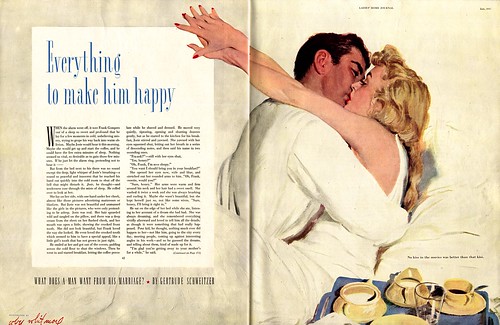
Anyways, I also just feel really compelled to like, you know, buy this thing or whatever because this ad really "speaks" to me:


I would really like this teapot set because it will make my man happy. 
Or help me find a man. 
Or find ~love~. 

Advertisements since the dawn of time (or since the dawn of advertisements) have preyed on both stereotypical gender roles and played-up fears to sell products to women. 


Advertisements have stressed the fact that things women do, anything from applying lipstick, to wearing perfume, or to cooking meals should be for the pleasure of men. A lot of these advertisements also use the opposite idea that these products help women keep their male partners happy. Or, if they do not have a significant other, that they can easily acquire one if they had these products.

Is it ethical for advertisements to portray that women need these things to make themselves attractive to men, or to keep their male partners happy?

Uhhhhhh....no.

If we evaluate these type of advertisements under the TARES framework, they would violate the respect paid towards women. These type of advertisements do not pay respect towards women as autonomous beings who function outside of the desire of males. It perpetuates the stereotype that women are second towards males in our culture, and can aggravate advertisements and attitudes like this:

Advertisements that place women in sexually or physically overpowered situations can perpetuate that these things are okay and are accepted in our culture, when they totally aren't.

When scenes like this are present in everyday culture, it trivializes the harshness of things such as rape and sexual violence towards women. Media, advertising companies and corporations have social responsibility that the advertisements used on their behalf do not endorse, normalize or trivialize serious matters.

Sunday, October 7, 2012

Blogs and Internet File Hosters

After the age of Limewire came and went, after universities started monitoring torrents on campus-wide internet -- music sharing took a different route.
And internet-based file hosting made it much easier to do that. 

By about 2010, I had perfected my technique of finding music using keywords on search engine sites. For example, if I was looking for the Sun City Girl's album, "330,003 Crossdressers from Beyond the Rig Veda," all I really had to do was type that in with either the word "blogspot", "rar" or "exe" to find a link to a full, downloadable copy of the album via some sort of specialized blog for exactly the type of music I was looking for. 

I've already come to the conclusion that taking music without paying for it is illegal and unethical, but hard to change by outside forces. However -- within the last two posts, it was clear who was receiving the short end of the stick. But who is actually hurt by these blogs?

 In my opinion -- not really anyone. The majority of these online blogs focus on rare, obscure and out-of-print musics from around the world. 


The labels that produce these albums aren't hurt by their distribution because many of these albums have been out of print for such a long time, and the artists are benefitting from a renewed interest in their work. 

However, these blogs can be used in the distribution for new, leaked music that can hurt album sales. 

I understand that. 

However, there are three parties who are technically in "the ethical wrong," however which one should take the fall? 

The person downloading music, the "stealer"? 
The blog for advertising the fact that you can and should illegally download music? 
Or the file hosting company for hosting these illegal files? 

According to Aristotle, the intent of the blogs is virtuous -- the idea of wanting to share music and culture for the greater empowerment of all peoples is virtuous, despite the the consequence.  So according to our Greek philosopher,  the blogs aren't at fault for anything, and the entire act is ethical. 

Hmm. Okay, let's try a different route. 

According to Kant, the ends (the cultural empowerment of people through music) don't justify the means -- and since the means of people downloading these musics are through these file hosting sites, they are in the wrong. 

Who is at fault, and can there be a consensus before things hit the fan? 

Nope. 

http://iamtheleastmachiavellian.blogspot.com/2012/09/mediafire-links-removal.html

http://bodegapop.blogspot.com/2012/01/guilty-until-proven-innocent.html

http://www.pcworld.com/article/230515/So_Youre_Being_Sued_for_Piracy.html

Sunday, September 23, 2012

MPAA: Trying to Convince People that Something is Unethical

Okay, put on your nostalgia hats and think back to that time you went to go see the first Harry Potter movie in theaters with your parents.

Are you there?

Good. Now, I'm sure you only remember how cute Rupert Grint looked before he hit puberty and how Slytherins sucked. But think about the previews BEFORE the movie. Does this seem familiar?

During the haydays of internet file sharing, the megalith trade association known as the Motion Picture Association of America, which includes almost every large movie corporation, created these PSAs to try to curb internet file sharing.

This 30 second video not only appeared as a trailer to many blockbuster films, but also on the DVD as a required trailer before the main menu of the movie. It's sorta weird that they put this in the front of PURCHASED DVDS -- essentially they are preaching to the choir and actually targeting the people who did not violate any copyright laws.

But to be honest, who is this video targeting? Making the implication that file sharing, is as bad as stealing a car completely distorts the reality of the situation and makes the whole thing into a big fat joke. According to many studies, observers draw a sharp moral distinction between file sharing and genuine theft, even when the value of the property is the same. However, is it ethical for the movie industry to try to change standards of morality to make sure their bottom line stays the same?

The ethical-ness of changing ethics, based on Kant's categorical imperative, is not ethical at all -- corporations using money, media and influence to change the individuals' ethics (action/means) in order for people to not steal (end/consequence) is unethical in and of itself, even if the end consequence is good.

According to Mill, changing the ethics of all of those involved to make sure that less people illegally download movies is also unethical. The action essentially deprives the majority of enjoying music / movies and other various forms of media, while it only benefits a few at the top with rewarding them with more money and influence.

This about to get way more ~metaphysical~ than it should be, but corporations, even if their advertisements made sense and actually targeted the illegal file-sharers, cannot change conscious values. If someone tells you that something is "ethically wrong," there is no way to make someone believe that. The moral change has to come from one's internal sense of good and bad, of right and wrong. Someone's moral standards -- due to their upbringing, culture, ethnicity -- are well-grounded. Advertisements like that are not going to change anything.

The semantics of how to address file-sharing/stealing/piracy can go on and on, however if the MPAA actually want to make a dent in the copyright infringement that's going on, they gotta work with the system and stream of ever-evolving technology.

Let's be real: this video is not changing anything. The weird flame-eye effect is just making me laugh really hard.


Sunday, September 9, 2012

Napster -- The birth of Internet Filesharing

Nowadays, it's pretty easy to just find any music, movie or media file on the internet if you want it.

That wasn't always the case.

At the turn of the century, file sharing clients, the most prominent being Napster, came into the limelight. This free file sharing services allowed users to share music, movies and whatever else you could think of with their peers -- completely for free.

"Okay Karina, make sure your files are above 128 bit rate so they sound good," explained my dad as he showed me how to download music on Napster. With a cable modem and my father's new Windows ME computer, I was a fifth grader with a blank check. I was awe-struck and amazed when I had the entire Blink-182 discography in my clutches, and how easy it was for me to find the new 50 Cent song I had heard on MTV2 using Napster.

I knew for a fact that I was happy listening to a whole bunch of cool music, and that my friends were happy because I was always burning them mix CDs. At the prime age of 10, I never really questioned if my actions of downloading music were exactly ethical.

Why would I question it? I was happy, my mom was happy to not have to spend $12 dollars on a crappy Celine Dion single I wanted, and my friends were happy to be able to listen to new music.

But, I was a pioneer and was actually thinking like Jeremy Bentham -- the greatest number of good for the greatest number of people. The act in and of itself MUST be good if everyone I knew was benefitting from my action and I didn't know anyone who was negatively affected by me downloading music. I also always believed that I was not the only one doing it -- I was only a small pawn in the cogs who downloaded a few tracks here and there and that there were always other, bigger, badder file-sharers who were doing wrong --- but definitely not me.

However, the ends can't really justify the means. Even though file sharers aren't physically taking CDs from stores or putting a copy of "Shutter Island" into their purses/large pockets at their neighborhood Blockbusters (does Blockbusters even exist anymore?), they are still enjoying something that someone put a lot of time and effort into creating, without paying for it. And that, in essence, is stealing.

Hate to say it, but most of the folks from my generation are thieves. I can't really blame them -- it's hard to actually feel guilty about "stealing" music when you have the anonymity of the internet to hide behind.

But really, technology is sorta awesome and is changing every day. What actually constitutes as "stealing" or being "ethical" is now blurred by something called the World Wide Web. And I really really wanted / needed / had to have that 50 Cent song on my 13th birthday party mix CD.