Monday, October 22, 2012

The commodification of gender

Sorry if I seem distracted during this post, but the debate is going on. I can't help but listen when I hear things about "nuclear centrifuges spinning faster and faster."

Anyways, I also just feel really compelled to like, you know, buy this thing or whatever because this ad really "speaks" to me:
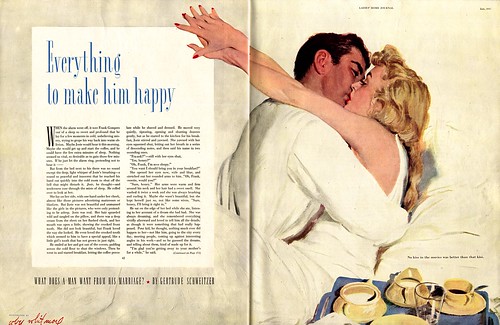

I would really like this teapot set because it will make my man happy. 
Or help me find a man. 
Or find ~love~. 

Advertisements since the dawn of time (or since the dawn of advertisements) have preyed on both stereotypical gender roles and played-up fears to sell products to women. 


Advertisements have stressed the fact that things women do, anything from applying lipstick, to wearing perfume, or to cooking meals should be for the pleasure of men. A lot of these advertisements also use the opposite idea that these products help women keep their male partners happy. Or, if they do not have a significant other, that they can easily acquire one if they had these products.

Is it ethical for advertisements to portray that women need these things to make themselves attractive to men, or to keep their male partners happy?

Uhhhhhh....no.

If we evaluate these type of advertisements under the TARES framework, they would violate the respect paid towards women. These type of advertisements do not pay respect towards women as autonomous beings who function outside of the desire of males. It perpetuates the stereotype that women are second towards males in our culture, and can aggravate advertisements and attitudes like this:

Advertisements that place women in sexually or physically overpowered situations can perpetuate that these things are okay and are accepted in our culture, when they totally aren't.

When scenes like this are present in everyday culture, it trivializes the harshness of things such as rape and sexual violence towards women. Media, advertising companies and corporations have social responsibility that the advertisements used on their behalf do not endorse, normalize or trivialize serious matters.


Sunday, October 7, 2012

Blogs and Internet File Hosters

After the age of Limewire came and went, after universities started monitoring torrents on campus-wide internet -- music sharing took a different route.
And internet-based file hosting made it much easier to do that. 

By about 2010, I had perfected my technique of finding music using keywords on search engine sites. For example, if I was looking for the Sun City Girl's album, "330,003 Crossdressers from Beyond the Rig Veda," all I really had to do was type that in with either the word "blogspot", "rar" or "exe" to find a link to a full, downloadable copy of the album via some sort of specialized blog for exactly the type of music I was looking for. 

I've already come to the conclusion that taking music without paying for it is illegal and unethical, but hard to change by outside forces. However -- within the last two posts, it was clear who was receiving the short end of the stick. But who is actually hurt by these blogs?

 In my opinion -- not really anyone. The majority of these online blogs focus on rare, obscure and out-of-print musics from around the world. 


The labels that produce these albums aren't hurt by their distribution because many of these albums have been out of print for such a long time, and the artists are benefitting from a renewed interest in their work. 

However, these blogs can be used in the distribution for new, leaked music that can hurt album sales. 

I understand that. 

However, there are three parties who are technically in "the ethical wrong," however which one should take the fall? 

The person downloading music, the "stealer"? 
The blog for advertising the fact that you can and should illegally download music? 
Or the file hosting company for hosting these illegal files? 

According to Aristotle, the intent of the blogs is virtuous -- the idea of wanting to share music and culture for the greater empowerment of all peoples is virtuous, despite the the consequence.  So according to our Greek philosopher,  the blogs aren't at fault for anything, and the entire act is ethical. 

Hmm. Okay, let's try a different route. 

According to Kant, the ends (the cultural empowerment of people through music) don't justify the means -- and since the means of people downloading these musics are through these file hosting sites, they are in the wrong. 

Who is at fault, and can there be a consensus before things hit the fan? 

Nope. 

http://iamtheleastmachiavellian.blogspot.com/2012/09/mediafire-links-removal.html

http://bodegapop.blogspot.com/2012/01/guilty-until-proven-innocent.html

http://www.pcworld.com/article/230515/So_Youre_Being_Sued_for_Piracy.html